Nacra 17
About
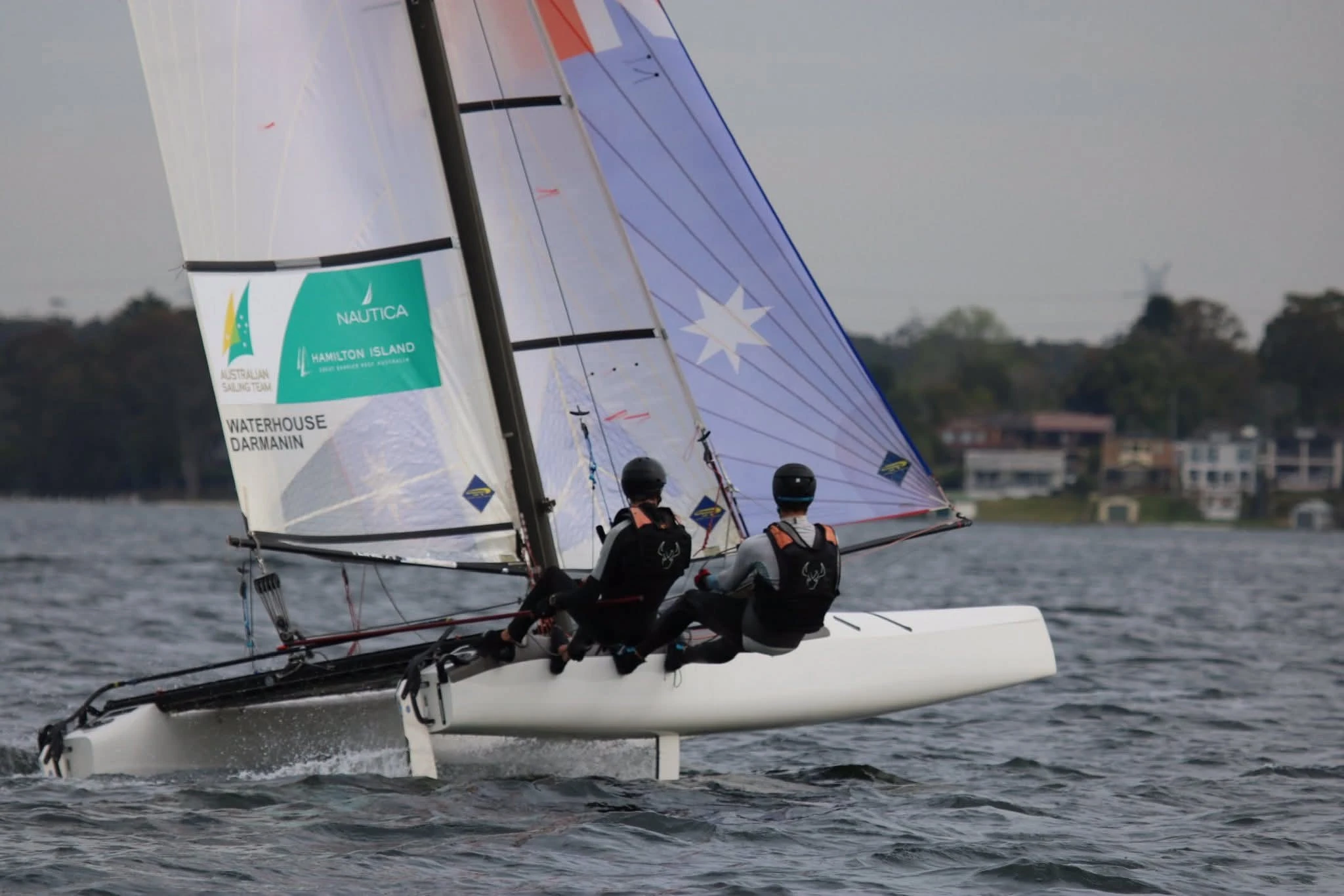
The Nacra 17 is the benchmark for high-performance multihull racing. Designed by Morrelli & Melvin for the 2016 Rio Olympics, this C-Foil variant represents a unique sweet spot in catamaran design. At 5.25 metres long and weighing just 142 kg, it is significantly lighter than the Formula 18 class while carrying a powerful, high-aspect rig.
While the class has since evolved into a fully foiling platform for the Tokyo and Paris Olympics, the original curved-board design remains a lethal regatta weapon. It offers the stability of a displacement hull with the lift and drag-reduction of a semi-foiler, making it an exceptional performer in handicap fleet racing.
The decision to campaign the Nacra 17 was driven by three strategic factors:
- Crew Weight: With a combined team weight of roughly 125 kg, we are too light to be competitive in the Formula 18 (F18) class, which favours crews closer to 150 kg. The Nacra 17 is perfect, allowing us to utilise our power-to-weight ratio effectively.
- Yardstick Parity: Crucially, the Nacra 17 shares an identical yardstick (Handicap) rating with the Formula 18. This allows us to race boat-for-boat against the largest high-performance fleet in Australia without relying on corrected time.
- Cross-Training: The semi-foiling dynamics and high-speed instability of the 17 provide the perfect cross-training platform for my foiling campaigns in the Nacra F20 FSC and SL33. It keeps my reflexes sharp and fitness high in a regatta environment that full foilers often cannot access.
With a combined team weight of roughly 125 kg, we found ourselves in a difficult position. We were too light to be competitive in the deep fleets of the Formula 18 (F18) class, yet the Formula 16 fleet in Australia lacked the volume for consistent high-level competition. The Nacra 17 became the perfect solution. It is longer, wider, and more powerful then our previous F16, which allows us to race aggressively at the front of mixed fleets. It bridges the gap between the F16 and F18, giving us a platform that punches well above its weight on yardstick rating.
The defining feature of this generation of Nacra 17 is the curved daggerboard (C-Foil). Unlike the straight boards of the F18/F16 or the Z-foils of the fully foiling Nacra 17, the C-foil offers a “semi-foiling” mode. Upwind, the boards track like a traditional daggerboard. However, as boat speed increases downwind, the curved profile generates significant lift. This reduces wetted surface area and hydrodynamic drag without the volatility and crash-risk of full flight.
The full carbon fibre mast provides a stark difference in responsiveness compared to aluminium rigs. The stiff rig translates gust energy directly into forward acceleration rather than flex, demanding constant attention to sheet loads and trim windows.
I had the unique privilege of racing a piece of Olympic history at the Nacra Sailing 50th Anniversary Regatta.
Thanks to our sponsors at Nacra Online, we campaigned the specific Nacra 17 hull that claimed the silver medal at the Rio 2016 Olympic Games, complete with its original Australian flag spinnaker outfit.
Notable Results
- 2nd Place Overall – Nacra 50th Anniversary Regatta (aboard Rio 2016 Silver Medalist Boat).
- 2nd Place Overall – Debut Regatta (Mixed Fleet), beating competitive F18 teams on elapsed time.